Statement. The Bugio lighthouse (Forte de São Lourenço do Bugio) stands on a sandbank at the mouth of the Tagus, about 8.6 km from Praia da Rainha in Costa da Caparica. We photographed it in summer 2026 through haze thick enough to turn it into an unproven conjecture.
In the Praia da Rainha proof, the Bugio lighthouse appears as a smudge on the horizon, and we captioned it an unproven conjecture. This post is the proof. Or at least a sketch, with the details filled in.
What is the Bugio lighthouse?
It is a round Renaissance fort on a sandbank in the middle of the Tagus mouth, built to guard the sea approach to Lisbon. According to the Portuguese Navy’s lighthouse service, construction was ordered in 1643 and finished around 1657. The outer wall is a circle about 62 metres across. The light on top was rebuilt after the 1755 earthquake and relit in 1775. It was automated in the early 1980s, has had no resident keepers since 1982, and has run on solar power since 1994.
The sandbank gave the fort its other name, São Lourenço da Cabeça Seca, the “dry head”: it was the only one in the area that stayed above the tide line all year round.
Why is it called Bugio?
One explanation points to the French bougie, a candle: a round tower with a light on top looks like a lit candle in its holder. It is not the only theory, but it is the prettiest. Bonus for engineers: in French, bougie also means spark plug. Same object, different ignition.
Can you see the Bugio lighthouse from Costa da Caparica?
Yes, and geometry agrees. The distance to the horizon from a height of h metres is roughly 3.57·√h kilometres. Standing on the sand, with your eyes about 1.7 m up, your horizon is about 4.7 km away. The Bugio light sits about 28 m above the sea, so its own horizon is about 18.9 km away. The two horizons add up: anything closer than about 23.5 km can, in principle, be seen. Praia da Rainha to Bugio is about 8.6 km as the crow flies. Theorem: visible.
In practice, the limiting factor is not the curvature of the Earth but the air. Haze scatters light and makes contrast decay exponentially with distance, the same maths we used in our post about fog. On our evening, the lighthouse sat right at the edge of visibility: there, but not provably so.
A lighthouse is a clock
Every lighthouse has a signature, its light characteristic, so that ships can tell one from another at night. Bugio’s is Fl G 5s: one green flash every five seconds. That is twelve flashes a minute, a frequency of 0.2 Hz, with a nominal range of 15 nautical miles. A lighthouse, in other words, is a very large, very patient metronome.
Field notes from the beach
Lighthouses are not the only thing worth pointing a lens at on this stretch of coast. A few outtakes from the same summer:
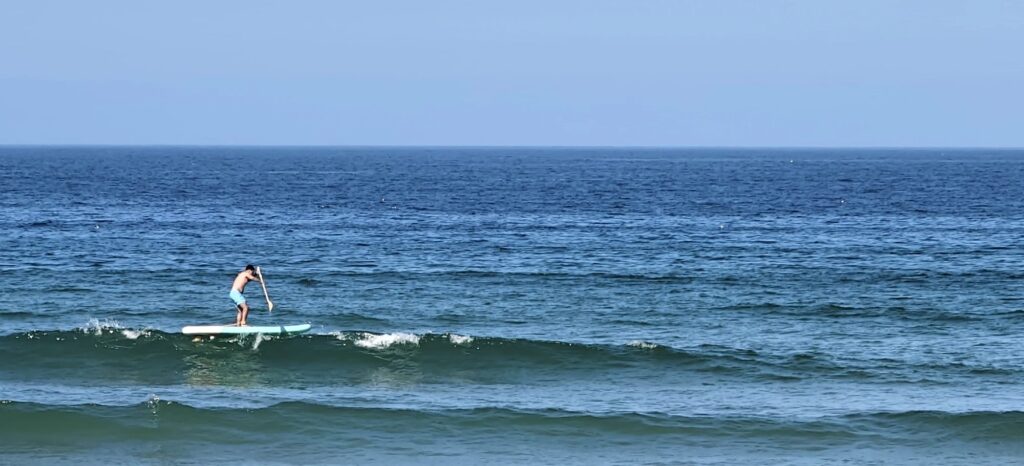
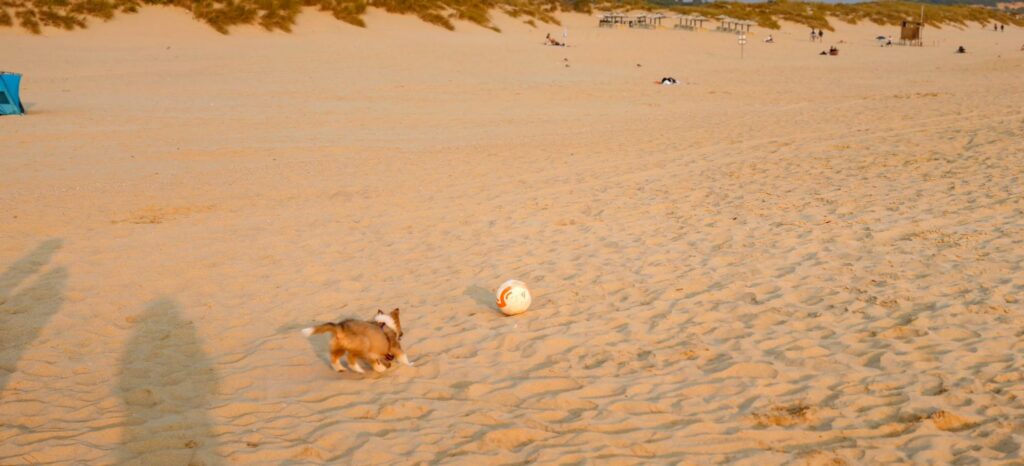
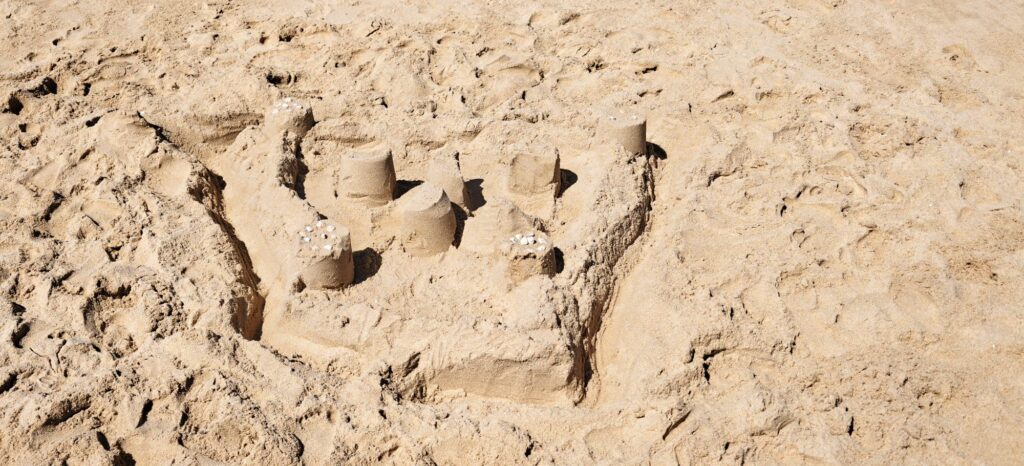
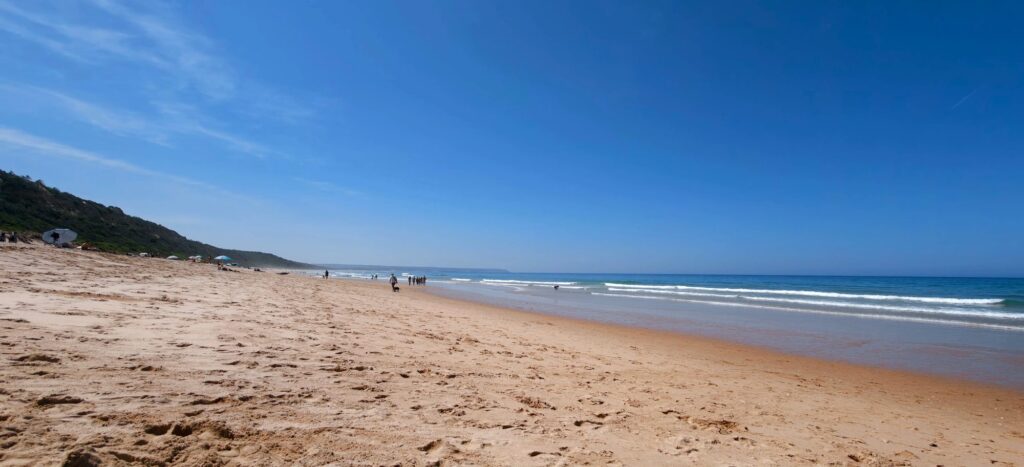
The full set of 11 frames, from the paddle boarder at golden hour to the Bugio in haze, is in Proof 002: Praia da Rainha.
Practical tips
- Golden hour: the beaches of Costa da Caparica face the Atlantic to the west, so sunsets happen right in front of you.
- Bring the zoom: at 8.6 km, the lighthouse is small. A 3x or 5x phone lens makes a real difference.
- Read the haze: if the far shore looks washed out, the lighthouse will too. Clearer air means more contrast, not a closer lighthouse.
- After dark: count the green flashes. If you get twelve a minute, you are looking at Bugio.
Frequently asked questions
Can you see the Bugio lighthouse from Costa da Caparica?
Yes. From Praia da Rainha it is about 8.6 km away, well within the geometric horizon, although haze can make it hard to see.
Why is the Bugio lighthouse called Bugio?
One explanation links it to the French word bougie, candle, because the round tower with a light on top looks like a lit candle in its holder.
When was the Bugio fort built?
According to the Portuguese Navy, construction was ordered in 1643 and finished around 1657. The lighthouse was rebuilt after the 1755 earthquake and relit in 1775.
What is the light signal of the Bugio lighthouse?
Fl G 5s: one green flash every five seconds, with a nominal range of 15 nautical miles.