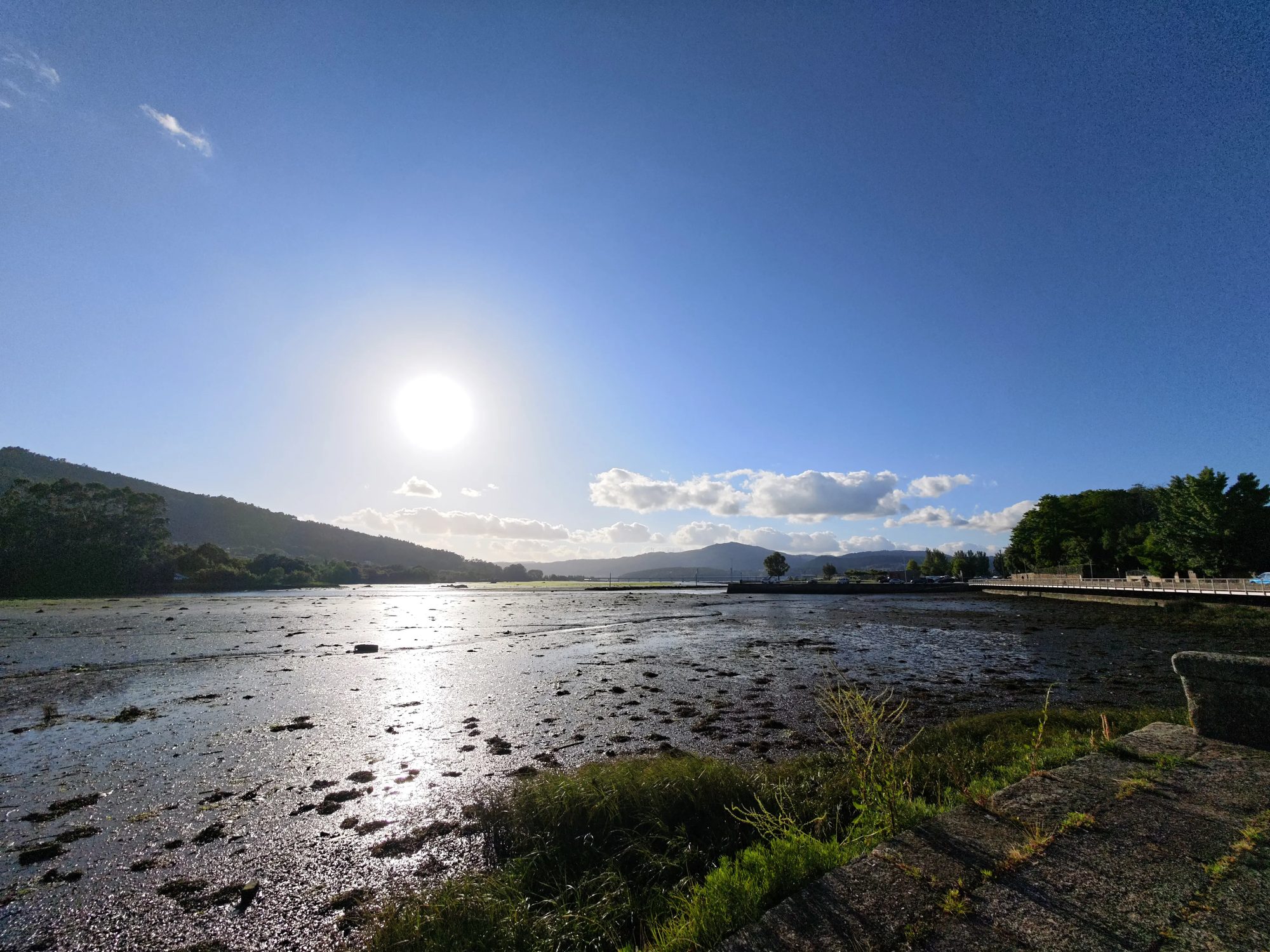
Statement. The Fervenza de Argalo, near Noia (A Coruña), is a waterfall of about seven metres on the Vilaboa stream, best seen after several days of rain, on an unsignposted track. We went in May 2026 and did not find it. A few days later, in Coentral das Barreiras (Serra da Lousã, Portugal), a waterfall found us.
Mathematics has a very unfair asymmetry. To prove that something is always true, you need an argument that covers every case. To prove it false, you need one example. One. This spring we tested the idea on two waterfalls.
Where is the Fervenza de Argalo, and why is it hard to find?
According to Turismo de Galicia, the Fervenza de Argalo sits on the Vilaboa stream, in the parish of Argalo (Noia). At about seven metres, it is the highest waterfall in the municipality. The track to it is not signposted, and the recommended time to go is after several days of rain.
We ignored both warnings and followed our intuition, which is the scientific equivalent of trusting a proof because it looks nice. We did not find the waterfall. We found the parish cemetery, where the church faces the opposite way to most churches: apse to the west, door to the east. At least we were not the only ones pointing in an unexpected direction.
So, for us, the Argalo waterfall remains a conjecture: a statement we believe, on reliable sources, but have not verified ourselves. That is a respectable status. Fermat’s Last Theorem spent 358 years there, from a margin note around 1637 until Andrew Wiles’s proof was published in 1995. You can see what we did find in the Argalo proof.
The counterexample: a waterfall in the Serra da Lousã
A few days later, in Coentral das Barreiras, a hamlet at about 725 metres on the southern slope of the Serra da Lousã (Castanheira de Pera), the water simply showed up: a small cascade over a mossy stone weir into a clear pool, with ferns on both sides and demoiselles patrolling the air. No searching required. The universe sometimes hands you the answer and pretends it was easy. It is all in the Coentral das Barreiras proof.

Strictly speaking, a waterfall in Portugal proves nothing about one in Galicia. Logic is merciless with wishful thinking. But it does refute a conjecture we had quietly started to believe after Argalo: that waterfalls are a myth invented by tourism boards.
Why one counterexample is enough
In 1769, Leonhard Euler conjectured that you need at least n n-th powers to add up to another n-th power. The conjecture survived for almost two centuries. In 1966, Lander and Parkin ran a computer search and found 27⁵ + 84⁵ + 110⁵ + 133⁵ = 144⁵: four fifth powers adding up to a fifth power. One line, and Euler’s conjecture was gone.
Our counterexample is less elegant, but it has ferns.
Corollary: practical tips
- Fervenza de Argalo: go after several days of rain and load the route on your phone before you leave. There are no signs, and intuition is not a GPS.
- Coentral das Barreiras: the valleys around the hamlet are full of streams and small cascades. Mountain roads are narrow and often foggy, so drive slowly.
- General rule: a conjecture you have not verified is not false. It is just waiting for rain.
We will go back to Argalo after a rainy week. If we find the waterfall, this post gets an update and the conjecture becomes a theorem.
Frequently asked questions
How tall is the Fervenza de Argalo?
About seven metres. According to Turismo de Galicia, it is the highest waterfall in the municipality of Noia (A Coruña), on the Vilaboa stream.
When is the best time to see the Fervenza de Argalo?
After several days of rain, when the Vilaboa stream carries enough water. In dry spells the waterfall can be much weaker.
Is the path to the Fervenza de Argalo signposted?
No. The track is not signposted, so it is best to download the route before you go.
Are there waterfalls near Coentral das Barreiras in the Serra da Lousã?
Yes. The streams around the hamlet form small cascades and clear pools, reachable on walking trails marked with red and yellow stripes.